Saturday, 7 April 2012

Freeks in the Asylum - Roger Ballen at the Manchester Art Gallery

The things I got, the things I worked out for myself, the clear conclusions of the process of the pictures that I didn’t need a guide for are listed below; there are a good deal more things that I didn’t work out, couldn’t fathom and still not sure I want to find out.

What seemed either clear from the outset or soon after studying the prints: They are all technically very proficient prints, the silver gelation and the archival digital prints, beautifully toned square images – I’m assuming this a camera format decision, and the reason for assuming so is partly because of the squareness but maybe more because the majority of the photographs contain information across the full image area; the earlier shots maybe less so, but certainly all the staged shots are “fully managed” productions, corner to corner. There was a switch as Ballen moved from the darkroom to the digital print, the silver gelation are all mounted such that the image area was window mounted with no paper margin, the early digital prints then had a white border; this was then replaced by margin-less digital prints. I suspect this is as much to do with available technology as an artistic statement. I was also intrigued by the way in the prints were hung – I saw a “step-wedge” of tones on the walls or partitions, from zone 0 through 10; the paper base white of the prints (10), the solid blacks (0) of the frames and then three different tones (3,5 &7?) that the frames were mounted on – see below: I wonder if that was intentional?  


Those that remember the dark room will have memories of how difficult it was to obtain “flat” prints – not flat in the tonal range meaning, rather the bending of the paper, I noticed that several of the silver gelation prints, clearly on fibre paper, still showed signs of buckling. Ballen must have seen this as he hung the prints, as he packaged them up for the exhibition, I wander about warping and the warped nature of these prints, especially with prints such as “Boy with Guns, West Transvaal” 1993
There are a limited range of props that Ballen uses, they can be seen a number of times, the duck, the dolls head, a toy rabbit, a toy dinosaur, some stuffed animals. The Outland (2001) – series starts to look staged. The “players” in the images start to look made up – feet and hands aren't dirty they are dirtied; whereas the leery-eyed subject of  “Wife of abattoir holding three puppies” 2004 isn’t staged – she is that person.

What I didn’t/don’t fully understand, what I question and what disturbs me is a fuller list. I can understand the “Outland” series - Outland means foreign - as Ballen was, when he arrived on the Veld taking a prurient interest in the small towns when he had time to spare; even more, the documenting of the townsfolk who appear to have welcomed him. But as the “project” wears on, as the interest delves deeper I begin to question the motivation.

I wrote: “Toys make up “Stories” from within or without. Within, the subjects, the country, the politics. From without -> Ballen? (meaning inside his head?).

As Ballen made his way around the townships on the Veld he noticed and recorded the time warp that existed (and maybe still does); I suppose he must have noticed the irony of the prurience of capturing the “Pensioner, Volksrust” 1984 as he stands, in what might be newly pressed pyjamas, next to his table above which are several pin-up photographs of sexually charged women, scantily dressed; this in a country who is still today coming to terms with the naked form, where censorship pervades all of society and, at that time, was probably at a standstill in Volksrust. Is this a document or a comment? The old native South African, head in the shadow in “Old Man, Ottoshoop” 1983 and “Tommy, Samson and a Mask” 2000 seem the only overtly political comment on the end of apartheid, not a criticism – just a comment.


The visual aesthetic seems to be fully formed by the time “Outland” appears, by then he has moved almost exclusively indoors and to stage managed shots; completing the control of all parts of the image and frame. Utilising text and a limited range of props and thematics, this visual vernacular doesn’t appear to develop. The semiotic toolbox of toys, knives, dead animals, grime, grit and mild shock doesn’t really move on as he dives deeper and deeper. This all tends to suggest that this isn’t a body of work that has any relevance to South Africa or the African continent, politics or poverty. It appears more to be about the exploration of the foreign country that resides in Ballen’s mind – he is that “Outsider” in his own phsychotic mind of Ballen.

The twin bodies of works “Shadow Chamber” and “Boarding House” push the boundaries of tolerance further and deeper than before, but there are clearer signs that these images are constructs of Ballen’s mind. The staging of, for example, the neatly cut holes in the cloth for three hands to appear in “Three Hands” belies the grit and grime of the image, although the technical brilliance of the images transgresses that aesthetic, it would seem, as the flowers are beautifully rendered in tender and immaculate detail. Some photographs give away their secrets much more easily in “Dazed” 2006 a new born puppy, a used/old condom, some twine (cord) and a knife are joined on set by a single piece of a jig saw puzzle. “Chuckle” 2006 had another cloth with apertures, this time for mouths agape as they scream or shout their message, though, again, they have very good teeth and offer another transgressive message against the grit, grime and shit of a subjugated life; these mouths are not in any immediate need of an orthodontist in the foreseeable future. The “Asylum” almost takes another variable away from the frame, that of the human, describing the human form with masks and charicature – Ballen takes the control of the picture further into his hands, further into his mind and as he does so the allure of his imagery moves further away from this viewer.

I was intrigued by a lot of the photographs - they were all intriguing - this shot left makes use of a single piece of scrawl on the wall and echoes it with the man's pose. I can't make that out. With the shot on the right I found myself comparing the chaos of the bundle above the head of the subject below and wondering if the chaos was an allegory for the contents of his mind - and that could be Ballen's or the sitters! And yet I was amused by the visual echo between the accordion and the chicken at the youth's feet!


By the end, I felt I had had a tour of Ballen’s mind (or at least a part of it), I was left wanting more of what appeared to have driven him there from the perspective of this exhibition. It started with a documentary of the world he found himself in, Dorps, Platteland; this exhibition seems to suggest that these travels drove him inside – from the outside world and maybe inside his head. This 30 year epic is a testament to his endurance, holding an aesthetic together for that journey, but it appears to me to be an isolationist journey, introspectively documenting the way by which Ballen copes with the world. The videos that are shown display graphically Ballen’s visual aesthetic, but not his temporal, for that the visitor needs to go to the “Asylum”.

This last shot also amused, but for different reasons:


Pictures by kind permission of the Manchester Art Gallery

Tuesday, 3 April 2012

Assignment 2 - The last conversation. The submission

These photographs were taken over 2 nights at an amateur theatre production of The Reunion, a comedy by Peter Gordon. I have followed the production from it’s first rehearsal, through the set building, the technical set-up and dress rehearsals leading up the opening 2 nights of performance, from where these photographers were taken.
I had a number of shots that I wanted to capture to describe the event, as if to a relative outsider to the process of a production of a performance. I was successful in some areas and less than successful in other areas. Where I failed was in obtaining a more than just competent “make-up” shot, those that I did obtain are included in my learning log and I think I could have done better with the “final bow”.
I was very pleased with some of the other shots, especially those that deal with the stress of an opening night, how actors cope with adoption of their roles as well as some of the “moments” in and around these people on a common cause. Some of these “moments” are personal, some are social, but the motif I have used to assemble this series is that of conversation. Theatre and acting are, in their simplest form, a means of communicating through visual and verbal means. Communicating to an audience and, at its limit, it is about communicating to “a” person, an individual member of the audience, in such a way as to engage that person and their fellow audience members to convey a story. It is a conversation, it relies, especially in comedy, on two way communication as the actors strive to engage their viewers. I did take some shots of the audience during the performance, but decided not to put them up here; rather this set is about the conversations prior to the performance, whether intensely personal or public.

Titles are for ease of recognition, though the photographs should be in the order as written about. I don’t normally title photographs.

Karen.

Opening night. Tense. More than half an hour to go as this shot was taken before the players move into the “green room” (so called because it is green). I think the composition works on this shot, right of frame with the rhythmic struts moving away from her. The focus is strong, centred on her eyes, her whole frame, exposed in this frame is in sharp focus, with the underlying thought that all of her is tense. Clutching her single prop, the handbag and holding her head as if to stop it exploding and staring as if to maintain focus on her entrance (third, after Verity and Ken) there appears to be an internal conversation with Karen and herself. I like this shot a lot – it seems to say a lot about the angst a player goes through before show time. I’m not sure how I would improve it. I felt instinctively that a portrait version would have been too static, although looking at it now, cropping at the first strut to Karen’s right would pictorially hem her in and maybe add to the tension. I have included a cropped version for comparison.


The “Lucky Programme” Prize

I suspect most amateur groups struggle for funds, this one is better off than most – due mainly to having members who write original work and don’t charge royalties (the second biggest cost of any production). So, apart from ticket sales, a raffle and a bar there is the “lucky programme prize”. Each charged for programme is numbered and the winner is drawn, as a lottery during the interval. This shot has Emma handing the winners prize to a member of the audience. The triangular construct (Emma, winner, bottle of wine) works well and is nicely balanced in the frame. However what amplifies its effect is another audience member looking up at the winner with a clear thought in his mind. Emma, is focused on the winner, who reciprocates, there is a clear conversation going on, both verbally and visually; but those other eyes add a complication to the conversation, as if they want to enter the conversation. It could be a challenge, it could be a need to congratulate – they certainly don’t look ill-willed toward the winner. Again I can’t think of a different crop, maybe a slight vignetting would help close the focus in on the area between Emma and the winner, though I think the reveal works better a little slower.

Kevin.

Opening night. I wasn’t aware that he wanted to speak to me. I was convinced he was in a moments pause, I also didn’t notice the bottle of wine in his hand. It was his gaze, his focus which seemed to detach him from the rest of the people in the Hall. The light was very strong, the west facing windows in the Hall can play havoc with stage lighting in late spring and summer shows and whilst most of the curtains had been drawn one had been left open providing a very strong contrast for Kevin, the soft “barn door effect” of the window edge cuts Emma off in a natural “toning down” of the left hand side and it’s effect can been seen coming into play on the right hand side. So, other than converting to monochrome, I didn’t need to do anything to separate Kevin from the world. There is a nice link between the two Directors and that is the “show-board” of photographs that almost connects them directly. The sharp focus of Kevin works very well. I have looked at a portrait crop and don’t think that it would improve the underlying sub text.
In fact Kevin was about to pay me for a commission he had given me after I had delivered some prints to him two days earlier, the wine was an additional gift. I had not noticed that the conversation was with me, not the viewer as I had imagined when I took the photograph.

Mugsy and Dave.

Mugsy (played by Jeff) and Dave who plays Mal’ (Malcolm). I phrased it this way as Mugsy is in role (costume) here, whilst Dave hasn’t donned the garb of Mal’ yet. I composed this shot through the mirror. The characters in the mirror are in focus, whilst out of the mirror the characters are out of focus. Mirrors have long been used in photography to develop narrative and this is no exception. There are three conversations going on here if we count the one of the three ladies reflected in the mirror. I shall focus on the two other ones. The real life conversation i.e. outside of the mirror is out of focus, could it be that they are role-playing? The in-focus is the reflected image, almost as if the surface of the mirror is the fourth wall that exists between actor and audience. There is a stage set in the mirror, a proscenium arch and tabs framing the action extremely well. Which life is real – the imaginary or the one in our zone? There are two expressions that we can see, neither is benign, Mugsy in the real world looks concerned, worried about what might be happening next, whilst Dave’s reflection looks almost angry, looking down on Mugsy. Mugsy is looked down on through most of the play, an army veteran with many references to Wesker’s character Smiler in “Chips with Everything” which is another play on class and pretension, though with a very different ending. I could have straightened the shot, but decided to leave with the edge of the imaginary proscenium arch anchoring the image, most everything else is “out of kilter”

Jeff.

I had taken a few of Jeff as he struggled to adopt the role on opening night. Where this shot worked better than the previous shots is the internal struggle is mirrored in the lighting of the shot. In the “green-room” there is only one light on – an angle poise lamp pointing generally into the room captures the left hand side of Jeff’s face (his right); when I looked at the image later it seemed to sum up that internal conversation Jeff was having with his fear, struggling to compose himself, to adopt the role. It is interesting that he always had his costume on long before anyone else, perhaps this also helped him to adopt the role. The very shallow depth of focus (which starts to run out just below his mouth) helps to isolate the “thinking” of Jeff. Monochrome is also a help I this shot. Not really sure how I would better this particular photograph with a different approach.

Three boys.

The Stage Manager sharing a moment with two customers at the bar; It could be a perfectly innocent moment or it could be a ribald remark. The centre of the image has the two men laughing heartedly at something. A moment in time, caught after a moment caused them to laugh. A moment later they would disperse. I saw the moment and took the image, I didn’t consider the leveling of the image at the time of taking and in this case I don’t think it detracts from the image, but I could try and shift the horizontal woodwork to level the image, but I think this crop helps in this case.

Emma.

In focus. Opening night. Less than an hour before curtain up. This is a shot about focus, Emma appears to be concentrating as if mentally reviewing a check list of the things that should be done and seeing if they have the green light. Off centre and to the left, other shots around this time had included Kevin, who, in clear concentration also, tended to be looking in another direction and visually confusing the “tightness” these two had generated in the preparation of their first production. I have thought about a portrait crop, but this looked very static, allowing this “off-centre” crop (as it was composed in camera) adds a bite of tension I feel. The eyes are very intense, much as Kevin’s were, albeit for different reasons.

Mal’ getting dressed.

This is the costume changing shot, in fact adopting the robes before curtain up (there are no costume changes to speak of in this show). The conversation between Mal’(Dave) and Lorraine (Alex) some time before curtain–up on opening night. Alex has already gotten into costume as Lorraine. I took a couple of this costume moment and this one has the most of Alex in shot which helps the viewer resolve Dave’s gaze and the focus of his conversation. There is a strong diagonal in the composition, helped by the fact that Dave was actually leaning to his right when I took the shot. Whilst the shirt is part of his costume, it isn’t necessarily strong enough as a costume shot, but it is a nice moment between the protagonists of the on-stage kiss before they assume their roles completely and adopt the personae of Mal’ and Lorraine.

The Laugh.

I anguished about this shot for the longest out of all the shots for the assignment. The reason for the hesitation is that there is another shot, taken just before this one where Karen – who we see out of focus here, is in sharp focus and is telling the story that now we see Sharon bursting out laughing about. I chose this because there is a line of travel in the image. The viewer naturally starts with Karen’s face, which is out of focus, but sees it is inclined to her right, the viewers left and this takes us to Sharon who is in sharp focusing and who is laughing like a drain. It is this effect of capturing this event, which, whilst it is a moment carries with it it’s own narrative. The laugh as a result of something that has happened (in this case a story of some sort) between these two people. The bodies are leaning in apparent opposition though strangely seem in sync; with each other. I’m not sure again, whether another crop would help this, though the bright “blob” top right is a bit of a visual encumbrance.


Mirror four, a nightmare.

This shot is one of my favourites. Shot into a set of wall mirrors, this picture has a rich set of metaphors that I noticed as I took it. The two characters that have lost some of their head are players due to go on stage shortly. The two characters in the foreground, whilst out of focus are back stage support who are relied upon to be absolutely reliable. And Emma, a director, who is central to the picture is only slightly visually aberrated – almost as if she has nearly got it all together. Verity, whose face has left her, seems almost as if she is waiting for her mask to be put on before going on stage, Ken’s head, his memory, his lines seem to have deserted him, both recurring nightmares for actors. The stage is back to front, another recurring incubus for actors is where the set changes overnight and the visual props reappear somewhere else destroying some of the continuity of repetition – and the support staff gaily carry on, not realising anything is untoward.
I appreciate that some of these metaphors may be lost outside of the world of stage and I also have to say that this dystopian view of the play didn’t materialise and not only were both Verity and Kevin very good the whole cast performed brilliantly.

The final bow.

Well not quite, as the show continued after this for another night. But I wanted to have a closing shot and what better way than to have the entire cast receive their plaudits from an enthusiastic audience. There is an audible conversation when the cast receives an ovation from an appreciative audience. The cast communing as one as they bow in unison, the hands from the audience as one, applauding the performers. I think these players deserved their accolades and the audience appreciated their investment in the evening’s entertainment. I could have composed this shot better; there isn’t enough of the audience clapping. The viewer can see the hands but I don’t think nearly enough, though the framing of the players on stage is about right – the play is set in the back room of a pub and they are framed by the twin tables full of bottles and empty glasses.

Karen, alternate crop. Not considered as part of the assignment entry


Sunday, 1 April 2012

The Second Conversation

Assignment 2 : People and Place

Down - select stages two and three:

Stage two:

Spending time studying a diminishing number of photographs is not something I’ve done a lot of and there is something that I would like to say about each of these photographs that didn’t get to the next and subsequent final round. I’ll limit the comments to a selection and attempt to explain the process I’ve gone through.
As I said in my previous entry the constant narrative that I searched for in the selection process was that of “conversation”; I searched in the original set for conversations of varying types, literal, metaphorical, private and internal. I was also aware that I needed to bring as much to the final selection as the assignment required, which included activity explanations as well as “telling moments”.


The second round cut starts with one of the final shots of the whole series, the “curtain call”. As the players take their place and bow to the applause of the audience we can see (or not, as the case may be) different conversations taking place. This first shot, taken with a flash attachment, on the left has two conversation taking place in the row of players and a third one with the audience and the players. Some of the players are “in position” whilst the others are “poised”. The audience is at one with themselves applauding the stage. The reason it was culled is that to better depict the final bow it would be more appropriate to have the actors as one with the audience. The other curtain call misses the applause as this shot was taken without a flash and the audience is in the dark, though some detail is present in the blurred hand-clapping, it isn’t strong enough (and the cast seem a bit disorganized as well). I hadn’t used flash for any of the performance or the rehearsal period, using it only at the last moment on the last performance I went to.

Jean and Pat in conversation – connected at eye level by the visual contrivance behind them works well I think, Jean’s expression and Pat’s attentive regard also helps. I had deliberately included Pat’s reflection in the mirror behind (I have used the mirrors a few times in this assignment as devices in composition), but I think on this occasion it detracts. I also think that the foreground figure would have made this photograph more telling if it had been inclined to Jean’s expressive profile. Mike, who was "technical" (lights and sound) along with Bradley, for this show enjoying both a pre-show drink of bubbly (a group tradition on opening night) and a conversation with someone; it is the fact that it is a “someone” that it has failed at this stage – the image is unresolved. It must go.


Conversation's that are either ill-defined from a compositional perspective or where the conversation appears unresolved and therefore not really amplifying the assignment call as well as photographs that, well, simply don't make the grade compared to later ones.

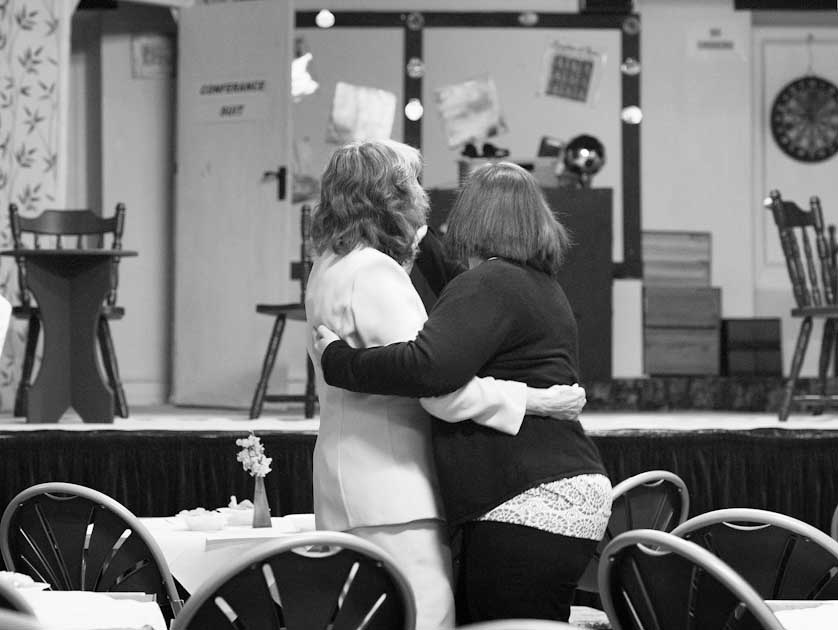
A complex conversation, the females intent on each other, whilst the male is portraying an "informant" to the viewer. This could be taken as two differing humours, I don't know what either set is smiling about, but there definitely seems to be two conversations at two levels going on here. On the right we can see clearly the conversation on view. This greeting an "embrace" between old friends, intimate and private, it could possibly be a word from the one on the right of the picture to the other, it is almost certainly a kiss. If the "kissee" had been more in shot then maybe it might have moved forward!

Getting changed. There isn't a changing room as such, the players get changed when and where they can. This show has a minimal set of costume changes, so there is little room for embarrassing moments, though in other shows decorum and tact need to play a significant part in the proceedings... I wanted to have some costume moments in the series. This one with Dave and Ken pre-show has them in conversation whilst donning the role. The shot on the right has a young person in one conversation via the mobile 'phone and as a mute correspondent in another conversation as the older person looks down on her. If there had been more tension in the photograph it might had made it further forward.

These two are in an animated conversation, ignorant of the rest of the world; but the shot is relatively placid and without a great deal of energy. Whereas there is a lot of energy in Jeff's profile as he prepares for his first entrance on opening night. I did two shots here - see later, and this one is worse in terms of blurring. There is motion blur around his head as he gets himself in the right state of mind for his entrance. Different players have different routines to get themselves across the boundary. I decided to talk about this particular shot as there is a nice allegorical statement about focus and blur, state of mind and approach to the entrance. The notes that surround him are the Stage Manager's notes. I think it portrays a good sense of tension, but this didn't make the cut as I think a better one did.


Third round cut before moving to the final phase I realised I needed to cut more to make the assignment number requirement.

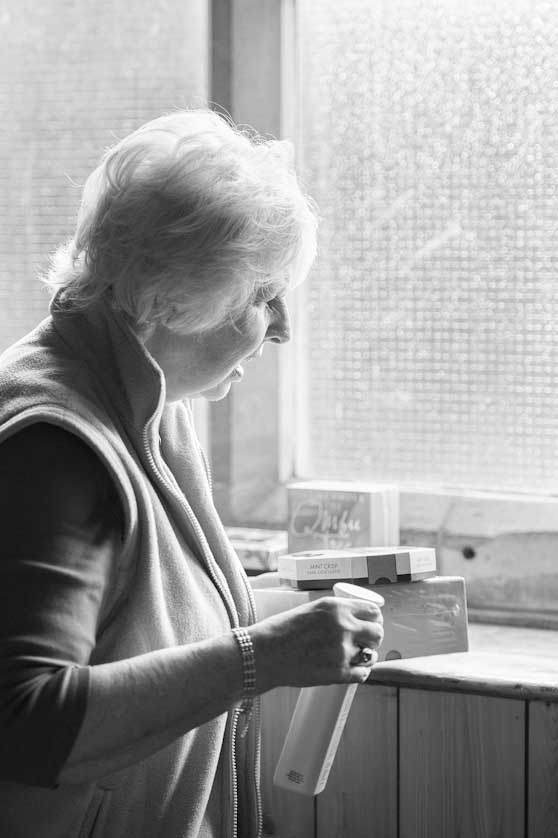
I was torn with this image on the left. Karen and Sharon involved in a private conversation. Karen graphically telling some part of the story and appearing to demonstrate with her hands under her bust; I think the link at this point with the production is helpful as Sharon holds the script towards the viewer. There is an intensity in Karen’s eyes and Sharon doesn’t need to be in focus, I feel there is enough of her in view (although out of focus in the main) to know that it is a conversation and between two people. There is a shot that I took moments after that I have chosen which is why this shot flounders at this stage. Another attempt at a make-up shot. This time the action is even more intimate, the application of lipstick with both the player and the make-up artist in focus and both caught in a reasonable composition. Hands on faces, hands close to lips, the player’s eyes on the process in front of her. Not many people get this close.


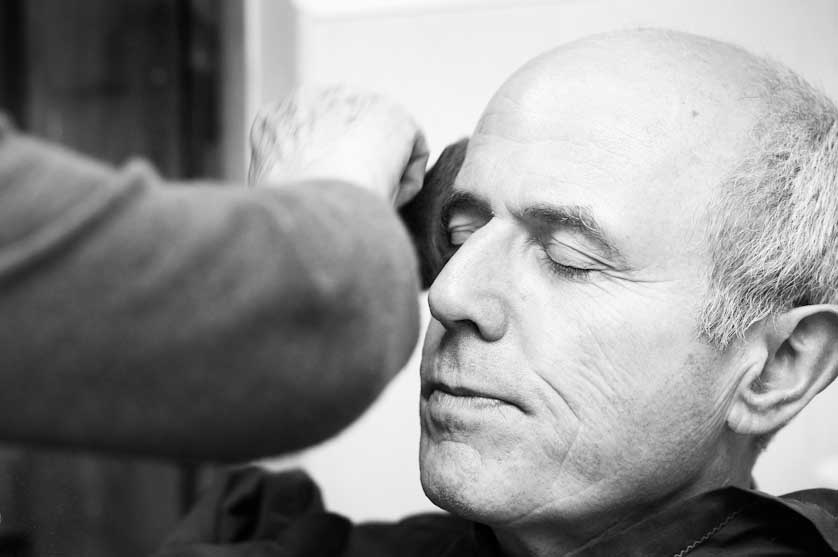
These two were the last to go. I was reluctant to chop the Make-up shot as I had reviewed the photographs from the first night and vowed to make an improvement. I decided to move in closer for these shots, to capture the intimacy and the connection better. This viewpoint make it difficult to get a visual connection between the faces of the two, but this one - discarded after it's twin shot below - seemed to offer most. There is a steady focus on Ken's face allowing the movement of the powder brush to do it's work, so there is physical connection, but maybe because the eyes are closed (for very good reason) it didn't make enough of a connection with the viewer and so failed at the last. This is disappointing as I wanted a make-up shot in the final down select and failed. The other last minute rejection has Pat and Jean in conversation. Pat in flow, engaged at eye level and fully in focus - on safe ground as it were, whilst Pat, out of focus is in abeyance in this shot.


Which leaves the final assignment selection