Sometimes in the theatre, at least in the legitimate theatre right after the opening night when the notices are viewed the production team may decide a rewrite is required. During a pre-season tour the rewrites are developed before the big opening "up West".
Well clearly this assignment won't run and run and needs a radical rewrite if it is to keep it's audience's attention. There are two images that remain untouched and one of those may be culled before I finish the review of this work, such as it is.
These photographs were taken over 2 nights at an amateur theatre production of The Reunion, a comedy by Peter Gordon. I have followed the production from it’s first rehearsal, through the set building, the technical set-up and dress rehearsals leading up the opening 2 nights of performance, from where these photographers were taken.
I had a number of shots that I wanted to capture to describe the event, as if to a relative outsider to the process of a production of a performance. I was successful in some areas and less than successful in other areas. Where I failed was in obtaining a more than just competent “make-up” shot, those that I did obtain are included in my learning log and I think I could have done better with the “final bow”.
I was very pleased with some of the other shots, especially those that deal with the stress of an opening night, how actors cope with adoption of their roles as well as some of the “moments” in and around these people on a common cause. Some of these “moments” are personal, some are social, but the motif I have used to assemble this series is that of conversation. Theatre and acting are, in their simplest form, a means of communicating through visual and verbal means. Communicating to an audience and, at its limit, it is about communicating to “a” person, an individual member of the audience, in such a way as to engage that person and their fellow audience members to convey a story. It is a conversation, it relies, especially in comedy, on two way communication as the actors strive to engage their viewers. I did take some shots of the audience during the performance, but decided not to put them up here; rather this set is about the conversations prior to the performance, whether intensely personal or public.
Titles are for ease of recognition, though the photographs should be in the order as written about. I don’t normally title photographs.
Karen.

 Opening night. Tense. More than half an hour to go as this shot was taken before the players move into the “green room” (so called because it is green). I think the composition works on this shot, right of frame with the rhythmic struts moving away from her. The focus is strong, centred on her eyes, her whole frame, exposed in this frame is in sharp focus, with the underlying thought that all of her is tense. Clutching her single prop, the handbag and holding her head as if to stop it exploding and staring as if to maintain focus on her entrance (third, after Verity and Ken) there appears to be an internal conversation with Karen and herself. I like this shot a lot – it seems to say a lot about the angst a player goes through before show time. I’m not sure how I would improve it. I felt instinctively that a portrait version would have been too static, although looking at it now, cropping at the first strut to Karen’s right would pictorially hem her in and maybe add to the tension. I have included a cropped version for comparison.
 It was thought that this shot might work better in colour, I had already considered the portrait crop and this was also felt to express the tension more than the landscape version. I am not convinced as yet and will have to consider it for a while. I think there is a greater focus in the portrait version, but the soft pastel colours of Karen's costume tends to militate against an anxious persona, maybe if the colour of the background were also more dynamic and less bland it might have helped to convince me more.
The “Lucky Programme” Prize

 I suspect most amateur groups struggle for funds, this one is better off than most – due mainly to having members who write original work and don’t charge royalties (the second biggest cost of any production). So, apart from ticket sales, a raffle and a bar there is the “lucky programme prize”. Each charged for programme is numbered and the winner is drawn, as a lottery during the interval. This shot has Emma handing the winners prize to a member of the audience. The triangular construct (Emma, winner, bottle of wine) works well and is nicely balanced in the frame. However what amplifies its effect is another audience member looking up at the winner with a clear thought in his mind. Emma, is focused on the winner, who reciprocates, there is a clear conversation going on, both verbally and visually; but those other eyes add a complication to the conversation, as if they want to enter the conversation. It could be a challenge, it could be a need to congratulate – they certainly don’t look ill-willed toward the winner. Again I can’t think of a different crop, maybe a slight vignetting would help close the focus in on the area between Emma and the winner, though I think the reveal works better a little slower.
There were a couple of areas that this shot could have been improved, firstly if the shot had been composed more to my left and therefore captured more of the face of the "winner" - though I am concerned that the sub-text of the extra pair of eyes in the audience may get lost and also a tighter crop might have helped; I had recognised this in my write up and include the tighter shot here in the absence of a shot to the left.
Kevin.

Opening night. I wasn’t aware that he wanted to speak to me. I was convinced he was in a moments pause, I also didn’t notice the bottle of wine in his hand. It was his gaze, his focus which seemed to detach him from the rest of the people in the Hall. The light was very strong, the west facing windows in the Hall can play havoc with stage lighting in late spring and summer shows and whilst most of the curtains had been drawn one had been left open providing a very strong contrast for Kevin, the soft “barn door effect” of the window edge cuts Emma off in a natural “toning down” of the left hand side and it’s effect can been seen coming into play on the right hand side. So, other than converting to monochrome, I didn’t need to do anything to separate Kevin from the world. There is a nice link between the two Directors and that is the “show-board” of photographs that almost connects them directly. The sharp focus of Kevin works very well. I have looked at a portrait crop and don’t think that it would improve the underlying sub text.
In fact Kevin was about to pay me for a commission he had given me after I had delivered some prints to him two days earlier, the wine was an additional gift. I had not noticed that the conversation was with me, not the viewer as I had imagined when I took the photograph.
Kevin was deemed one of the weakest shots, so I have not tried to replace him with a different version, rather I have brought in another photograph altogether:
Pat and Jean

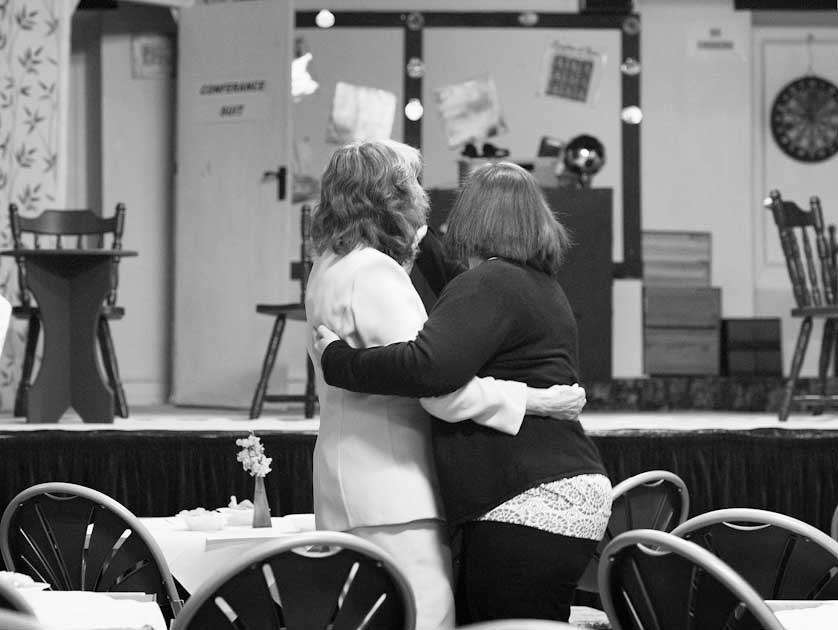
I had cut this in the previous round of downselect, though for this rework I have rotated the image to level the line that appears between the two sets of eyes that connect the to ladies in conversation. I am aware that the third person has his back to the camera, but I feel that he is superfluous to the conversation and has little impact. I have worked the area to the left of the image to remove any visual distractions.
Mugsy and Dave.

Mugsy (played by Jeff) and Dave who plays Mal’ (Malcolm). I phrased it this way as Mugsy is in role (costume) here, whilst Dave hasn’t donned the garb of Mal’ yet. I composed this shot through the mirror. The characters in the mirror are in focus, whilst out of the mirror the characters are out of focus. Mirrors have long been used in photography to develop narrative and this is no exception. There are three conversations going on here if we count the one of the three ladies reflected in the mirror. I shall focus on the two other ones. The real life conversation i.e. outside of the mirror is out of focus, could it be that they are role-playing? The in-focus is the reflected image, almost as if the surface of the mirror is the fourth wall that exists between actor and audience. There is a stage set in the mirror, a proscenium arch and tabs framing the action extremely well. Which life is real – the imaginary or the one in our zone? There are two expressions that we can see, neither is benign, Mugsy in the real world looks concerned, worried about what might be happening next, whilst Dave’s reflection looks almost angry, looking down on Mugsy. Mugsy is looked down on through most of the play, an army veteran with many references to Wesker’s character Smiler in “Chips with Everything” which is another play on class and pretension, though with a very different ending. I could have straightened the shot, but decided to leave with the edge of the imaginary proscenium arch anchoring the image, most everything else is “out of kilter”.
This shot doesn't have a direct replacement, it was felt that there were too many backs in the series as a whole and in this shot in particular. However, whilst I have some contention with that view I agree that the image may be too complex and that I have looked for imagery that only I can make out. My thoughts behind the image as I took it were: Whilst we see two backs, we also see their fronts, we see two different conversations between two separate people, overlaying this the two sets of people (characters and real-life) are distinguished by being fully in focus and out of focus - a real conversation and a fictional conversation. The resolution is left to the viewer. I'll leave it where it is for a time and perhaps come back to it later.
Jeff.

I had taken a few of Jeff as he struggled to adopt the role on opening night. Where this shot worked better than the previous shots is the internal struggle is mirrored in the lighting of the shot. In the “green-room” there is only one light on – an angle poise lamp pointing generally into the room captures the left hand side of Jeff’s face (his right); when I looked at the image later it seemed to sum up that internal conversation Jeff was having with his fear, struggling to compose himself, to adopt the role. It is interesting that he always had his costume on long before anyone else, perhaps this also helped him to adopt the role. The very shallow depth of focus (which starts to run out just below his mouth) helps to isolate the “thinking” of Jeff. Monochrome is also a help I this shot. Not really sure how I would better this particular photograph with a different approach.
Jeff was felt to be another weak shot and it didn't present itself to the viewer as I thought I had depicted him - I have therefore decided to reject this image as well.
Mobile communication

I had seen this shot as a potential contender and I have included a "slightly worked" version. I was intrigued by the counter play of the two heads in the picture. The one fully focussed on the mobile 'phone and the other looking on. The "out of focus" head representing - to me at any rate - an older generation that hasn't come to terms with the need of younger people to be in communication seemingly at all times. I have cropped the shot a little tighter and rotated it a little to try and add some tension.
Three boys.

The Stage Manager sharing a moment with two customers at the bar; It could be a perfectly innocent moment or it could be a ribald remark. The centre of the image has the two men laughing heartedly at something. A moment in time, caught after a moment caused them to laugh. A moment later they would disperse. I saw the moment and took the image, I didn’t consider the leveling of the image at the time of taking and in this case I don’t think it detracts from the image, but I could try and shift the horizontal woodwork to level the image, but I think this crop helps in this case.
Three boys was felt to be another weak shot and again didn't fulfill the brief. I can see why this was so and because I knew that one of the "boys" was the stage manager it made sense to me. This of course doesn't help the viewer who has no back knowledge. I have decided to reject this image.

Another shot that nearly made the final cut last time through is a moment when this lady seems to express herself quite dramatically. The original crop had more space around this lady and not much more around the person she was addressing herself to. I have cropped in tighter to amplify her expression.
Emma.

 In focus. Opening night. Less than an hour before curtain up. This is a shot about focus, Emma appears to be concentrating as if mentally reviewing a check list of the things that should be done and seeing if they have the green light. Off centre and to the left, other shots around this time had included Kevin, who, in clear concentration also, tended to be looking in another direction and visually confusing the “tightness” these two had generated in the preparation of their first production. I have thought about a portrait crop, but this looked very static, allowing this “off-centre” crop (as it was composed in camera) adds a bite of tension I feel. The eyes are very intense, much as Kevin’s were, albeit for different reasons.
The same shot closer, cropped and tilted to add some drama. I can see that I got lost in the moment of the first shot, though I did think that editing was cheating! The replacement shot is more direct, more focussed, emphasising her intent for the evening and the production. I also worked on some of the local contrast as recommended.
Mal’ getting dressed.

This is the costume changing shot, in fact adopting the robes before curtain up (there are no costume changes to speak of in this show). The conversation between Mal’(Dave) and Lorraine (Alex) some time before curtain–up on opening night. Alex has already gotten into costume as Lorraine. I took a couple of this costume moment and this one has the most of Alex in shot which helps the viewer resolve Dave’s gaze and the focus of his conversation. There is a strong diagonal in the composition, helped by the fact that Dave was actually leaning to his right when I took the shot. Whilst the shirt is part of his costume, it isn’t necessarily strong enough as a costume shot, but it is a nice moment between the protagonists of the on-stage kiss before they assume their roles completely and adopt the personae of Mal’ and Lorraine.
The Laugh.

 I anguished about this shot for the longest out of all the shots for the assignment. The reason for the hesitation is that there is another shot, taken just before this one where Karen – who we see out of focus here, is in sharp focus and is telling the story that now we see Sharon bursting out laughing about. I chose this because there is a line of travel in the image. The viewer naturally starts with Karen’s face, which is out of focus, but sees it is inclined to her right, the viewers left and this takes us to Sharon who is in sharp focusing and who is laughing like a drain. It is this effect of capturing this event, which, whilst it is a moment carries with it it’s own narrative. The laugh as a result of something that has happened (in this case a story of some sort) between these two people. The bodies are leaning in apparent opposition though strangely seem in sync; with each other. I’m not sure again, whether another crop would help this, though the bright “blob” top right is a bit of a visual encumbrance.
This shot was mostly acceptable although the suggested crop above was thought to perhaps convey the moment better. I'm still not sure but will live with it for a while to see how it works for me. Another comment was made about both ladies being in focus, which is the shot that I intentionally moved away from when I made this final selection - something to think about going forward.
Mirror four, a nightmare.

This shot is one of my favourites. Shot into a set of wall mirrors, this picture has a rich set of metaphors that I noticed as I took it. The two characters that have lost some of their head are players due to go on stage shortly. The two characters in the foreground, whilst out of focus are back stage support who are relied upon to be absolutely reliable. And Emma, a director, who is central to the picture is only slightly visually aberrated – almost as if she has nearly got it all together. Verity, whose face has left her, seems almost as if she is waiting for her mask to be put on before going on stage, Ken’s head, his memory, his lines seem to have deserted him, both recurring nightmares for actors. The stage is back to front, another recurring incubus for actors is where the set changes overnight and the visual props reappear somewhere else destroying some of the continuity of repetition – and the support staff gaily carry on, not realising anything is untoward.
I appreciate that some of these metaphors may be lost outside of the world of stage and I also have to say that this dystopian view of the play didn’t materialise and not only were both Verity and Kevin very good the whole cast performed brilliantly.
Too complex, too many illusions/allusions, too many backs. Firstly the backs are fronts as the ladies are reflected, but that doesn't matter, if the viewer doesn't get it, it has failed. It needs to go.
I have thought about something that my tutor said about the connection between the players and the audience, about trying to depict that conversation. I did take a number of shots during the performance and have decided to put this up to see how I feel about things for a while.

Here I have made use of the mirror again, this time to place the production in the middle of the audience. I am conscious of two things: firstly the number of backs in the picture, my tutor suggests it is symptomatic of timidity to have people's backs rather than fronts on view, however it would be a brave man to get in front of an paying member of the audience during a production and start snapping away! Secondly, It is a complex picture, so it may fall away after I have looked at it for a while.
The final bow.

Well not quite, as the show continued after this for another night. But I wanted to have a closing shot and what better way than to have the entire cast receive their plaudits from an enthusiastic audience. There is an audible conversation when the cast receives an ovation from an appreciative audience. The cast communing as one as they bow in unison, the hands from the audience as one, applauding the performers. I think these players deserved their accolades and the audience appreciated their investment in the evening’s entertainment. I could have composed this shot better; there isn’t enough of the audience clapping. The viewer can see the hands but I don’t think nearly enough, though the framing of the players on stage is about right – the play is set in the back room of a pub and they are framed by the twin tables full of bottles and empty glasses.
I have only offered one shot in colour, I may change that as I develop some credible vernacular moving forward. I do feel this whole piece is now quite complex but I felt I needed to get this moving, and then come back to it. If I had left it much longer some of the energy I had worked up on the assignment may well have dissipated. I know I can't re-submit. I also know now that it is a weak assignment and will ultimately affect my assessment should I decide to carry on that far.