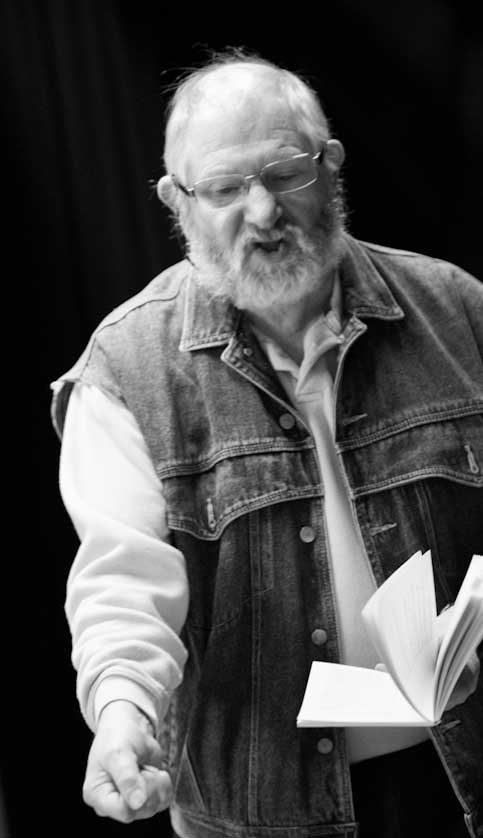
Assignment brief - … take (a photograph of) one person as a subject and create between five and seven different portraits.
Portrait.
Painting, picture, drawing, sketch, likeness, image, study, miniature, portrayal, representation, depiction, impression, account, profile. Oxford Thesaurus.
Representation of a person or animal, esp. of the face, made by drawing, painting, photography, etc. Oxford Concise Dictionary.
 |
| 1 |
In his book – “Camera Lucida” - Roland Barthes describes the process of finding a photograph, of his deceased mother that has the “air” of her, as a momento. Barthes goes on to describe how this image is the essence of his mother, the one image that carries the “authenticated” version of his mother. The “Winter Garden” photograph he declares has the “air” of his deceased mother, it is an image taken of her as a young girl.
Dr. Cynthia Freeland in her book “Portraits and Persons” discusses a similar process whereby she and her mother, hunt through some photographs of her grandmother and when her mother asks ‘Isn’t this one just really her?’1 Freeland writes “(I) knew exactly what she meant….. the photographer had caught some essential truth about her expression….” Daughter and granddaughter were equally convinced that this was “the” photograph.
 |
| 2 |
Richard Brilliant in his book "Portraiture" states... "Portraits partake of the artificial nature of masks because they always impersonate the subject with some degree of conviction. What, if anything, lies behind he mask can only be inferred by the viewer from the clues provided by the mask, which may mislead as well as inform through the use of conventions of representation. Ultimately, the emergence of the subject revealed in the portrait must take into account the fact that self-effacement be hind the mask is consistent with the social nature of men and women, all of who (re) present themselves in public."5
I tend to favour Brilliant’s view, inasmuch as a sitter will adopt a pose, whether prescribed or not by the artist. A viewer perusing a portrait of any person, known or unknown, can only judge the "air" by their emotive response to the image in view. Seeing, for example, the Mona Lisa, the age old questions arise about smile, who and why?There has been a lot said about this lady, though no-one has definitively said what this portrait says about the model. Da Vinci hasn't elaborated and is unlikely to do so now. So we are left to derive for ourselves whether it is a smile, and if so, what is she smiling at?
I have struggled with this concept that a (single) portrait can capture an essential truth, some expression of the “soul” of the person being portrayed, either as a painted or more specifically photographed portrait.
 |
| 3 |
My contention is that a portrait works when the treatment of the subject offers a transcendence that elicits a metaphysical response from within the viewer, and it does this because the viewer comes to the image equipped with their own portfolio of emotions that are ready to be tapped. A “good” portrait is one which bridges this distance between the two dimensional object and the sub-conscious mind of the viewer. It is clearly easier to do this if the image is of someone known to the viewer, but a skilled portraitist is able to do this with an unknown subject. There is but one quality that a portrait needs and that is engagement. If the portrait (or for that matter any image) can capture some attention long enough for the narrative to develop between viewer and image then it has passed it's first hurdle. With a portrait there are further tools to be considered, whether there needs to be extraneous clues or whether like Avedon a white background suffices? If there are semiotic clues and if so how prominent should they be. My own portraits for this exercise make use of both animate and inanimate objects to "paint" a picture of my sitter.
 |
| 4 |
 |
| 5 |
Portraits have, for the greatest amount of “image making history”, largely been the domain of the painter and their benefactor. Painters have been commissioned to portray the royal and the regal, the statesmen and the nobility. The rich and powerful have, for many reasons, needed to present portraits of themselves which are hung in prominent positions – those reasons will be left unexplored here. The other chief protagonists of the portrait have been the domain of the non-secular members of society, whether to create icons in the guise of particular religious figures, or to create icons of the members of the church establishments. These portraits, painted in increasing technical brilliance, have portrayed people in the likeness as described by the benefactor, more usually the subject. These portraits are likely therefore to deliver whatever was the demand delivered to artist. He who pays the piper calls the tune.
 |
| 7 |
 |
| 6 |
Whereas the rich, the landed and the establishment, had the wherewithal to have the portraits painted in the style that best suited their “view” of themselves; the eventual democratization of the portrait didn’t happen until the invention of the “physiognotrace”, a device that enabled the tracing of a person’s silhouette in quick order such that the price became within the means of (at least the wealthier end) on the general public. It was said that whilst a painted portrait might cost about $50 the “shade” might cost about 6c! 2 At its peak, studios were producing 1000’s of these “likenesses” a year. This volume of imagery was further dwarfed by the development of the daguerreotype, which reproduced the likeness of the sitter in a way that surpassed even the most skillful fine artist in terms of veracity and so popular were they that by 1853 there were eighty six galleries producing a total of three million images a year in New York city alone3 – such was the demand for likenesses to be created and for all the same reasons we take pictures today. Eastman Kodak with the Brownie and then the advent of digital technology have taken these “early adopter” numbers and stretched them beyond anyone’s wildest imagination. Flickr – just one of the social networks specializing in image storage - had about 5 billion uploaded images in 2011 and it’s community were uploading more, at a rate of 3000 per minute; what percentage of these were portraits probably isn’t known, but it is probably safe to suggest that about a quarter have people in them?
 |
| 8 |
The portrait is now no longer a domain defined by the size on one’s estate, though it is still a sociological remnant that the painted portrait continues to carry a level of authority that a photograph cannot aspire to, at least not yet. The painter edits the portrayal “off canvas”, the inclusion of any stroke of the pen, brush, charcoal is a determined effort; whilst the photographer aims to do this by exclusion of extraneous imagery and by technique to engage with the viewer. However the painted portrait still carries a “status” imbued by history as an emblem, almost fetishized in halls of power and privilege as recognition of achievement. The need for people to have “portraits” of themselves or of their loved ones, was demonstrable even before the availability of even reasonable mirrors that could discern for the sitter whether the likeness was indeed very strong, leaving the third party viewer to impart the affirmation of whether the portrait had the “air” of the sitter.
 |
| 10 |
 |
| 9 |
“Our social personality is a creation of the minds of others.” Marcel Proust, 1918 “4. I would contend that Freeman is at best optimistic in her being able to obtain “a” photograph that depicts a universal “air” of her grandmother that anyone might deduce from the portrait. Barthes decides not to publish his memento of his mother, claiming it has significance only for him. Brilliant goes close by his corollary of the mask.The first pass at a “portrait” of Mark was done a few weeks ago – I had a few things in mind – son, father, husband, musician – different traits of a young man that I hoped I could depict. Most of the images I had in mind seemed to work and I have added a few more. To test my theory I printed the images chosen for this assignment and sought answers from people. I can’t say that this process is in any way scientific, the sample size is way too small, but the findings are as below and interesting only as far as they go. The photographs that I added were the husband and wife shot, the brother shot, the hand shot. I asked everyone the same question; “pick out one photograph that shows the “air” of Mark, his “essence”. I said that no-one could pick more than one – it did produce some interesting conversations!
The first person I asked was his mother, my wife. Isn’t it true “no-one knows her son better than his mother”?? Well Alison’s choice was number 4. Closer still to the subject (at least to a different side) is probably his wife, Natalie chose 6. Nana chose 9, Granddad chose 8, Grandma chose 6, Auntie Lynn chose 4, Cousin Helen chose 1. I did ask Mark himself and for interest only, it was also 6 – his choice will be discounted as choosing your own “air” smacks of self delusion. I jest. I did not choose as I have the full back catalogue in my possession and can peruse at will.
Mmm, not entirely convincing evidence for the Freeman argument, that “a” photograph could provide an essential image that conveyed the “air” of a subject. These were all “close family”. I may ask people who have never seen Mark, whether the same question and see at least whether any of them choose the majority shot.
A photographic portrait is a limited tool to deliver a sitter’s personality, but a series could possibly do so. The range of shots of Mark cover certain aspects of his life, display some of his character.
1/2/3 - Portraits and Persons – Cynthia Freeman – OUP 2010 p42,43/64/69
4 - Face. The new photographic portrait - Thames and Hudson, William A Ewing, 2008, p106
5 - Portraiture - Richard Brilliant - Reaktion - 1991, p89

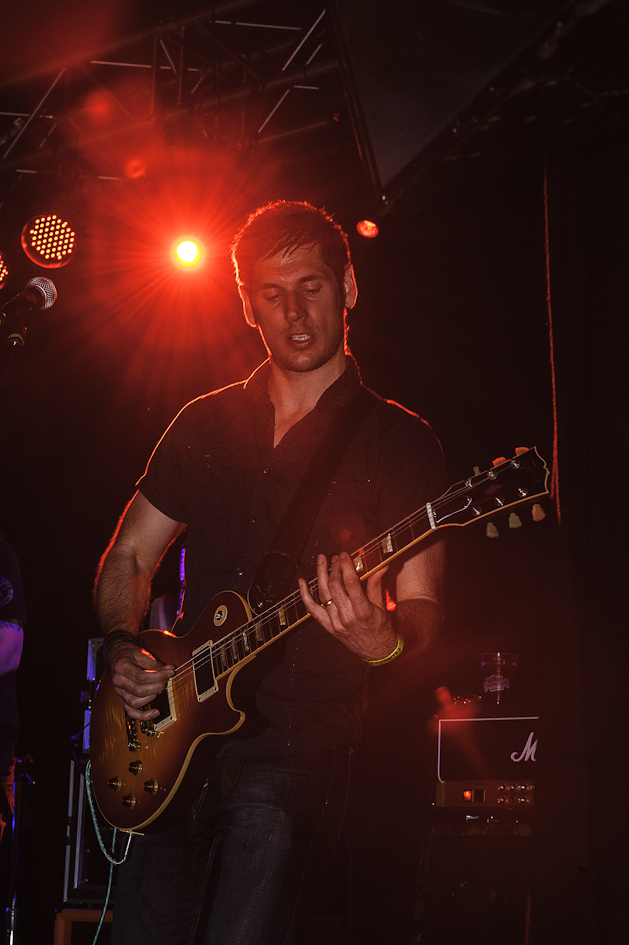


 So, what did I learn
from this exercise? Always support your children - no matter that they drive
you to the edge of sanity! It was difficult to try and negotiate with the
extremely bulky bouncer who was “protecting” the band from, well who knows
what, during a performance which delivered more decibels in one sitting than is
surely safe to consume over several sittings. Best to get there early and
consider the angles, talk to the people in charge and prepare - though I
suspect I won’t make a career out of this genre. Don’t be too put off by the
smell of youth, whilst getting in close, or by the “old guys” who dress up in
extremely tight t - shirts whilst adopting “moves” to seemingly attract the
barely post pubescent females in some curious courtship ritual which dictates a
lot of very vigorous head shaking and a great deal of wobbling in the stomach
area.
So, what did I learn
from this exercise? Always support your children - no matter that they drive
you to the edge of sanity! It was difficult to try and negotiate with the
extremely bulky bouncer who was “protecting” the band from, well who knows
what, during a performance which delivered more decibels in one sitting than is
surely safe to consume over several sittings. Best to get there early and
consider the angles, talk to the people in charge and prepare - though I
suspect I won’t make a career out of this genre. Don’t be too put off by the
smell of youth, whilst getting in close, or by the “old guys” who dress up in
extremely tight t - shirts whilst adopting “moves” to seemingly attract the
barely post pubescent females in some curious courtship ritual which dictates a
lot of very vigorous head shaking and a great deal of wobbling in the stomach
area.